It Is Not What You Tell AI, It Is How You Make It Think
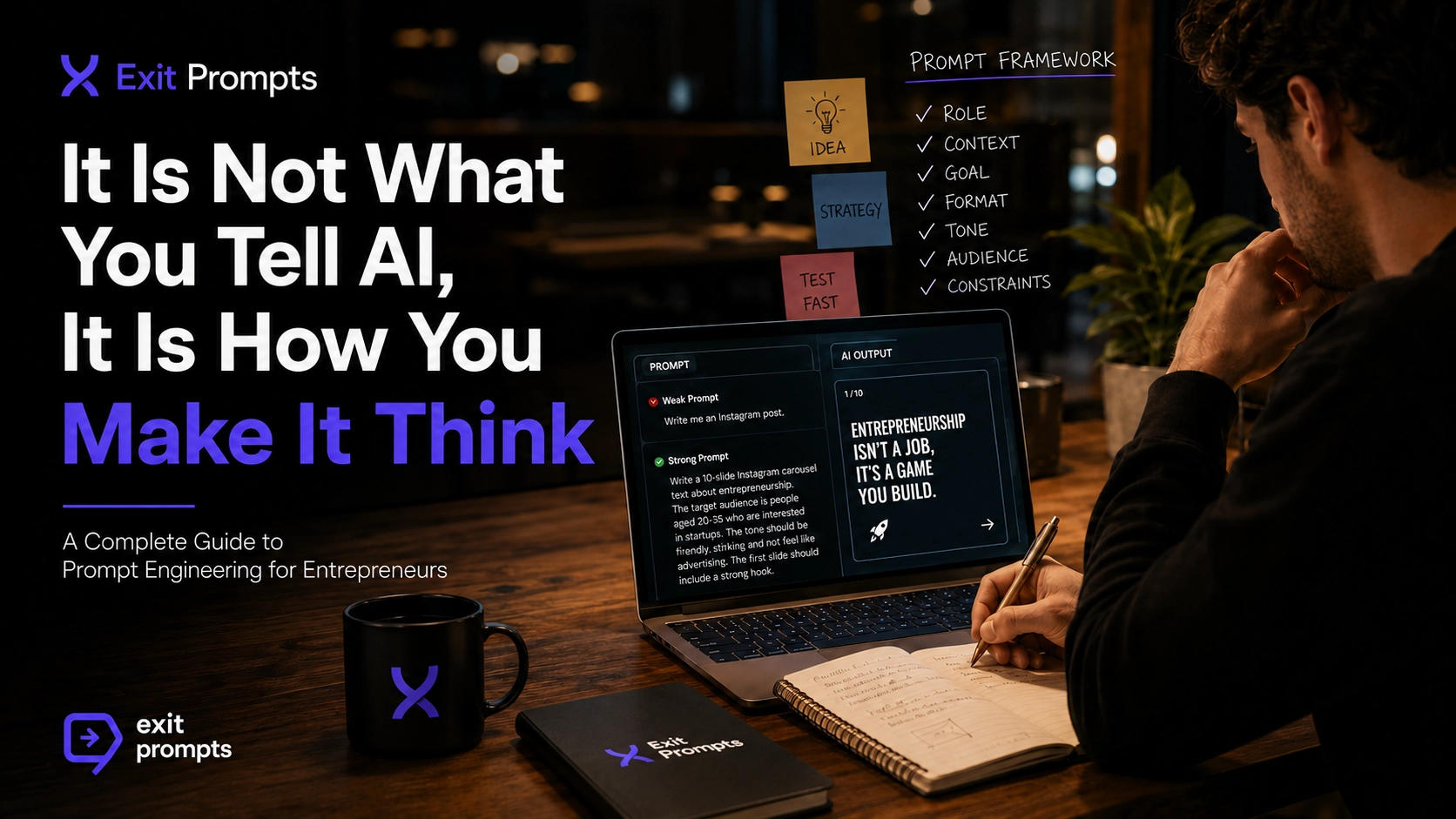
It Is Not What You Tell AI, It Is How You Make It Think
Since AI tools entered our lives, everyone has been asking the same question:
Why do some people get excellent results from AI while others settle for ordinary answers?
The answer is often hidden not in the model, but in the prompt.
No matter how advanced AI becomes, if you explain what you want in a vague, incomplete or scattered way, the result will be scattered too.
This is where prompt engineering comes in.
Prompt engineering is the skill of consciously designing the instructions, context, tone, format and goal given to artificial intelligence. It is not only a technical skill of the new era. It is a reflex for organizing thought, defining problems and managing outputs.
What Is Prompt Engineering?
Prompt engineering is the practice of making commands given to AI tools more accurate, clear and efficient.
In simple terms, it is the process of structuring natural-language inputs to obtain more specific and useful outputs from generative AI models.
But the point is not simply “asking ChatGPT something.”
The real point is this:
Know what you want, describe it correctly and put AI on the right thinking track.
Just as vibe coding shifts the focus from “writing code” to “describing the product,” prompt engineering shifts the focus from “using AI” to designing thought with AI.
Weak Prompt vs Strong Prompt
A weak prompt says:
Write me an Instagram post.
A stronger prompt says:
Write a 10-slide Instagram carousel text about entrepreneurship. The target audience is people aged 20-35 who are interested in startups. The tone should be friendly, striking and not feel like advertising. The first slide should include a strong hook.
Both prompts may seem to ask for the same thing.
But the second prompt gives AI a goal, format, tone, audience and use case.
That is the difference.
AI gives everyone the same tool, but not everyone gets the same result. The difference is not only access to the tool. It is how you direct the tool.
Why Prompt Engineering Matters
The quality of the result often depends on the quality of the instruction.
Prompt engineering matters because AI systems do not read your mind. They respond to the information, context and constraints you provide.
A good prompt helps AI understand:
- What the goal is.
- Who the audience is.
- What format the output should follow.
- What tone should be used.
- What should be included or avoided.
- What kind of reasoning or process should guide the answer.
The better the frame, the better the output.
What Prompt Engineering Changes for Entrepreneurs
Prompt engineering creates a major speed advantage for entrepreneurs.
In entrepreneurship, one of the most expensive resources is time. Testing an idea, defining customer segments, writing a landing page, creating ad copy, conducting market research or preparing an investor presentation no longer has to take days.
The old process often looked like this:
Idea -> Research -> Copywriter -> Designer -> Developer -> Test
The new process can look like this:
Idea -> Right prompt -> Fast output -> Revision -> Test
Prompt engineering helps entrepreneurs with:
- Clarifying an MVP idea.
- Creating target audience analysis.
- Conducting competitor analysis.
- Writing landing page copy.
- Producing advertising campaigns.
- Preparing social media content.
- Writing sales emails.
- Creating a pitch deck outline.
- Summarizing user feedback.
- Building a product roadmap.
The real value is not only speed. It is the ability to think more clearly through the process.
Tools and Use Cases
Prompt engineering is not limited to one AI tool. Different tools are useful for different workflows.
ChatGPT
ChatGPT is widely used for content production, strategy development, text editing, ideation, coding, analysis and education.
For entrepreneurs, it is especially powerful for:
- Developing business ideas.
- Creating brand voice.
- Producing social media content.
- Outlining blog posts.
- Creating customer personas.
- Preparing sales and email copy.
Success here does not come from saying “write me something.” It comes from giving the right role, context, goal and output format.
Claude
Claude stands out for long-form text, analysis, document reading, strategic thinking and natural writing.
Entrepreneurs can use it for:
- Summarizing long reports.
- Analyzing user interviews.
- Thinking through a business model.
- Producing natural blog or text drafts.
- Preparing strategy documents.
Writing a good prompt for tools like Claude does not only mean giving a command. It means loading the right context into the model.
Gemini
Gemini is useful for workflows connected with the Google ecosystem.
It can support:
- Market research.
- Presentation drafts.
- Email and document production.
- Daily workflows inside Google tools.
- Combined visual-and-text tasks.
Midjourney, DALL·E and Visual AI Tools
Prompt engineering is critical not only for text, but also for visual generation.
A weak visual prompt says:
Create an entrepreneur image.
A stronger prompt says:
A young entrepreneur working at night, product dashboard open on a laptop screen, modern startup office, lo-fi atmosphere, cinematic lighting, realistic photo style, vertical composition for a social media carousel cover.
This difference matters greatly in brand, advertising and social media production.
Prompting Guide AI
Prompting Guide AI can be used as a resource for people who want to learn prompt engineering techniques systematically.
Prompt engineering is no longer random trial-and-error. It is a learnable, systematizable and improvable skill.
Core Prompt Engineering Techniques
1. Clarity and Specificity
The more clearly you speak to AI, the better the result.
Bad prompt:
Give me a brand idea.
Good prompt:
Suggest 10 creative brand names for an Instagram page in Turkey focused on technology and business for young entrepreneurs. The names should be short, memorable and modern.
Clarity reduces randomness.
2. Role Assignment
Asking the model to act like a specific expert strengthens the frame of the response.
Example:
You are a growth marketing expert with 10 years of experience. Prepare a low-budget marketing plan for a new AI tool to acquire its first 1,000 users.
The role gives the model a perspective.
3. Defining the Format
Knowing what you want is important, but telling AI how the output should look is just as important.
Example:
Give the answer in table-style text. Columns: Problem, Solution, Target Audience, Revenue Model.
This saves time especially in blog, social media, presentation, advertising and business plan production.
4. Few-Shot Prompting
Few-shot prompting means teaching the desired format by giving examples.
Example:
Write 5 new hooks in the style below.
Example 1: “Nobody told you this, but...”
Example 2: “This brand grew from zero like this...”
Now produce 5 entrepreneurship-themed hooks in the same tone.
Examples make expectations more concrete.
5. Step-by-Step Thinking
For complex tasks, asking the model to break the problem into steps can produce better results.
Example:
Analyze this business idea first by target audience, then problem, then solution, then revenue model and finally risks.
This is useful when you need structure instead of a quick answer.
6. RAG and Context Engineering
Prompt engineering alone is not always enough.
Sometimes the model needs a current document, customer comment, product document, dataset or internal company knowledge to answer correctly.
This is where context engineering becomes important. In real business workflows, the goal is not just to get a nice answer. The goal is to get a sourced, current and reliable answer.
The Critical Side of Prompt Engineering
Prompt engineering is powerful, but it is not a magic wand.
The biggest risks include:
- The model producing false information.
- The user using output without checking it.
- The prompt being too leading.
- Entering confidential or sensitive information into the model.
- Handing every problem to AI without thinking.
- An increase in similar and soulless content.
- Prompt injection and security vulnerabilities.
Prompt engineering helps you get better answers from AI.
But humans must still check whether the answer is correct, secure and useful.
The Main Message
Prompt engineering is not only one of the technical skills of the future. It is a skill of thinking, describing and directing.
In the AI era, the person who makes the difference is no longer only the person who has information.
It is the person who can turn information into the right question.
Writing a good prompt is becoming the new interface of good thinking.
Sources and Further Reading
- Wikipedia - Prompt engineering
- IBM Think - What is prompt engineering?
- Prompting Guide AI
- Veri Bilimi Okulu - Prompt Engineering Nedir?
- Medium / SabancıDx - Prompt Engineering Nedir?
Ready to generate your own prompt?
Put what you learned into practice with our AI prompt generator.
Go to Generator →