If You Have an Idea, You Have Code: How Vibe Coding Is Changing Entrepreneurship
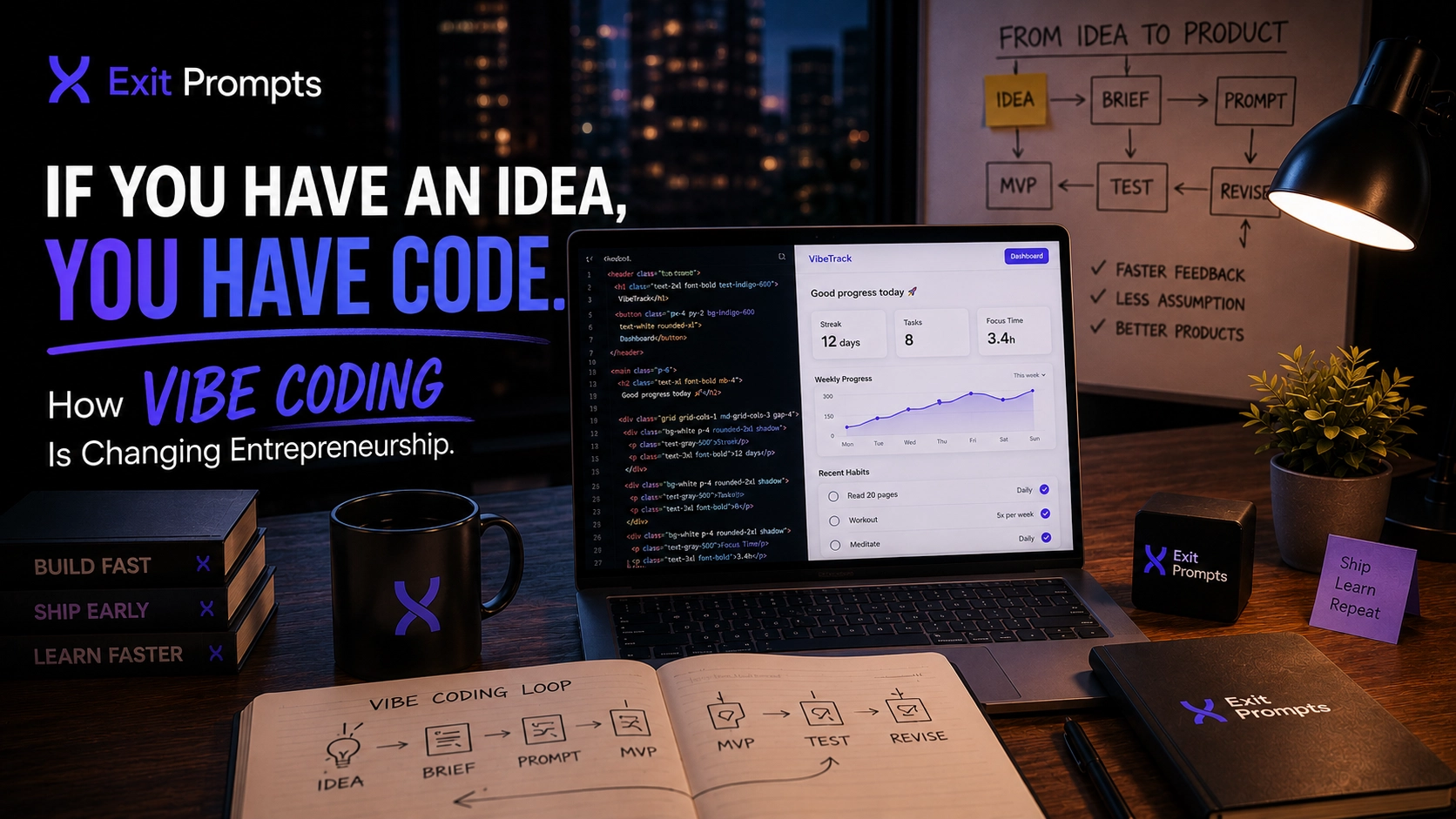
If You Have an Idea, You Have Code: How Vibe Coding Is Changing Entrepreneurship
There was a time when bringing an idea to life meant either becoming a developer or finding one. Today, that picture is changing. An entrepreneur, designer, content creator or student can describe what they want and create a working app, website or MVP.
The name of this new production reflex is vibe coding.
Vibe coding is not the end of software development. It is a shift that widens the entry point into software creation. The real change is not only technical. It is cultural. In the past, knowing how to code was the gate. Today, describing the right problem is becoming the key.
What Is Vibe Coding?
Vibe coding is a new-generation software development approach where users describe what they want in natural language, and AI-powered tools turn that intention into executable code and functional products.
In this approach, the human role shifts from writing every line of code to defining the idea, giving context, testing outputs and steering the product.
For example, this sentence is no longer only a product brief:
Build a simple dashboard where users can log in, add products and create orders.
With the right tool and context, it can become a direct production command.
That is why vibe coding is not simply “asking AI to write code.” It is a new way of moving from idea to product.
Why Did It Explode Now?
Vibe coding became more visible because three forces matured at the same time:
- Large language models became better at generating and editing code.
- Agentic coding tools started to connect prompting, file editing, testing and deployment.
- Entrepreneurs began demanding faster ways to test ideas before investing heavily in development.
The result is a shorter path from idea to MVP.
The old process often looked like this:
Idea -> Find a developer -> Allocate budget -> Build -> Launch
The new loop is faster:
Idea -> Explain it to AI -> Create an MVP -> Collect feedback -> Revise quickly
This does not mean the second path is always better. But it does mean more people can now test ideas earlier.
The Transformation for Entrepreneurship
For entrepreneurs, vibe coding changes the cost of experimentation.
Before, a simple MVP could require a developer, a designer, a technical plan and weeks of waiting. Now, a founder can create a first usable version, show it to users and learn from feedback much earlier.
This matters because most startup ideas do not fail because the first version is not perfect. They fail because the team learns too late.
Vibe coding makes the learning cycle faster.
It helps entrepreneurs:
- Turn rough ideas into working prototypes.
- Test product flows before hiring a full technical team.
- Create landing pages, dashboards and internal tools quickly.
- Iterate based on user feedback instead of assumptions.
- Reduce the emotional and financial cost of trying.
The main advantage is not that AI removes all difficulty. The advantage is that it lowers the barrier to the first version.
Tools Shaping the Vibe Coding Ecosystem
Different tools serve different types of users. Some are designed for non-technical founders, while others are built for developers who want to move faster.
Lovable
Lovable is positioned as a powerful vibe coding tool for people who want to move quickly from idea to web application. It is especially attractive for entrepreneurs who have an idea but no technical team.
According to company statements, Lovable passed major revenue and usage milestones in 2025, including more than 10 million projects created on the platform and significant annual recurring revenue growth.
Lovable’s rise shows that vibe coding is not only about “writing code with AI.” It is becoming a new product development infrastructure for people with ideas.
Replit
Replit evolved from a browser-based development environment into an agentic software creation platform. It aims to bring natural-language app creation, running and deployment into one place.
Replit shows both sides of vibe coding: speed and accessibility on one side, and the risks of uncontrolled AI usage in production environments on the other.
Cursor, Bolt, Windsurf and Claude Code
The ecosystem is becoming more specialized:
- Cursor is useful for developers who already know how to code but want to accelerate their workflow with AI.
- Bolt is strong for fast frontend and web app prototypes.
- Windsurf focuses on an AI-assisted IDE experience and project-based development.
- Claude Code is useful for more technical users working with terminal and project files.
- Lovable is strong for people who want to move quickly from idea to web application.
- Replit is strong for users who want code, runtime and deployment in one place.
The important point is this: vibe coding is not one tool. It is an ecosystem.
The Vibe Coding Loop
The most useful way to understand vibe coding is as a loop.
1. Idea
Clarify the problem and the target user.
A weak idea says:
I want to build an app.
A stronger idea says:
I want to build a simple habit-tracking app for students who want to study consistently with friends.
2. PRD or Brief
Write the product features, user flows, data structure and goal.
The better the brief, the better the AI output.
3. Prompt
Give the AI tool context, goals, constraints and output format.
Instead of saying:
Build me an app.
Say:
Build a mobile-first web app with user login, habit creation, daily streak tracking, group progress pages and a clean dashboard. Use simple UI, clear navigation and readable code.
4. MVP
Generate the first working version, deploy it and make it showable.
The goal is not perfection. The goal is to test whether the idea deserves more time.
5. Test
Show it to users, collect feedback and observe where they get confused.
6. Revision
Fix through prompting, check the code, version it and try again.
Vibe coding becomes powerful when it is connected to user feedback, not when it is treated as a one-shot magic trick.
Risks and the Balance Point
Vibe coding democratizes production, but it does not eliminate responsibility.
The biggest risks include:
- Code quality: Even if AI output works, it may be weak from an architectural perspective.
- Security: Authentication, data access and secret key management require attention.
- Maintenance: Code that is not understood becomes harder to change as it grows.
- Data loss: Uncontrolled AI commands in live databases and production environments can cause serious damage.
- Similarity: Many similar, low-quality applications may emerge.
This is why vibe coding should not be seen as a replacement for technical judgment.
It is a way to build faster, not an excuse to stop thinking.
The Real Meaning of Vibe Coding
The real power of vibe coding is not that it completely removes coding. Its power is that it accelerates the reflex to build.
Code still matters. Architecture still matters. Security still matters.
But at the early stage, the difference often comes from how quickly an idea can become a working product.
Vibe coding gives more people that chance.
The future of software creation may not belong only to those who can write every line of code. It may also belong to those who can define the right problem, give the right context and guide AI toward a useful product.
Sources and Further Reading
Ready to generate your own prompt?
Put what you learned into practice with our AI prompt generator.
Go to Generator →