Before ChatGPT: Cahit Arf and Thinking Machines
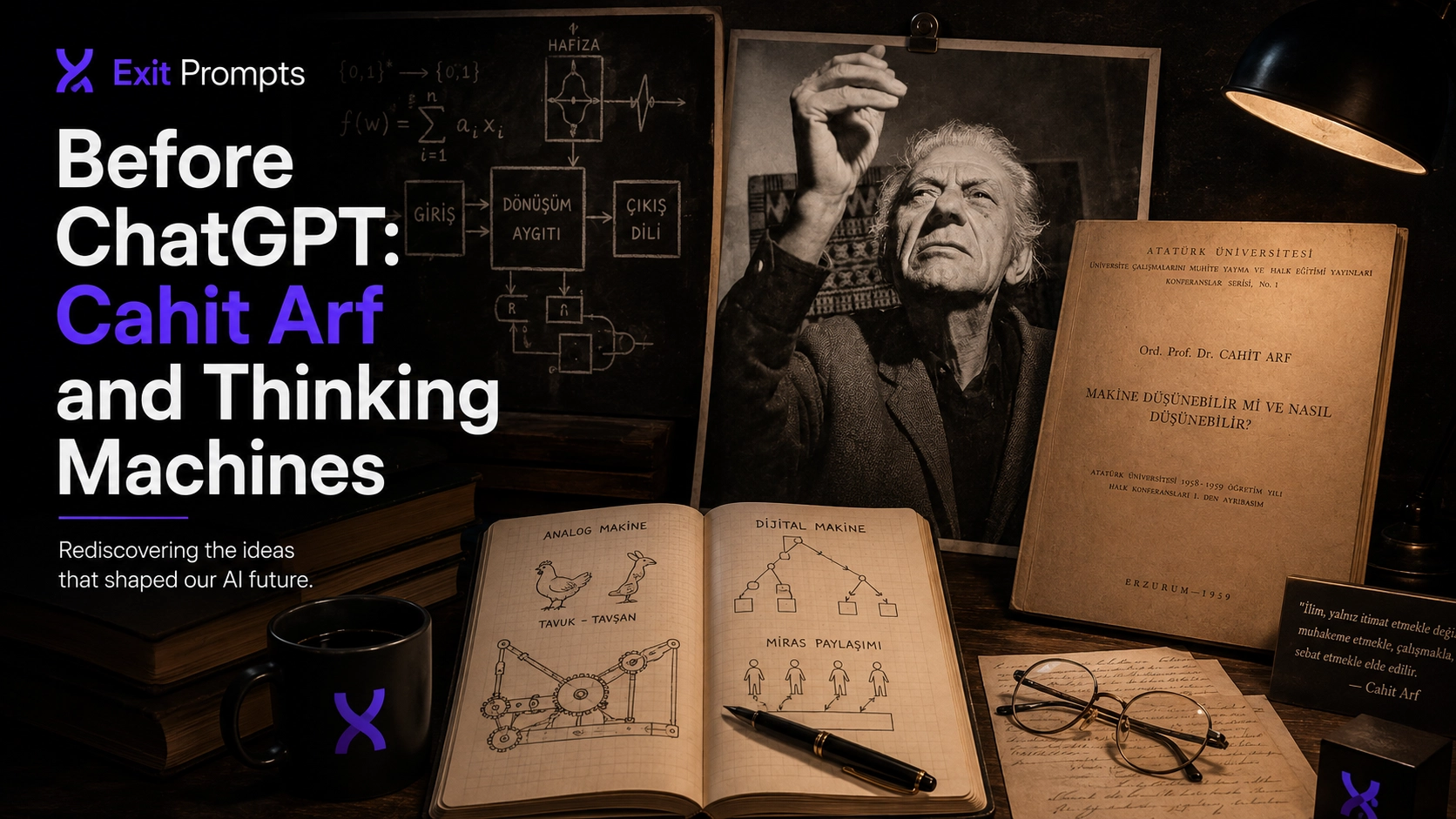
Before ChatGPT: Cahit Arf and Thinking Machines
Today, when we think of artificial intelligence, ChatGPT, generative AI tools, automation systems and algorithms come to mind.
Yet the question “Can a machine think?” is much older than we assume.
One of the most important figures in Turkey to take this question seriously was Cahit Arf.
In his 1959 lecture, “Can a Machine Think and How Can It Think?”, Arf discussed machines not as miracles, but as understandable systems. His approach reminds us of something important today:
To understand artificial intelligence, we must first stop being fascinated by the technology and start understanding the way of thinking that creates it.
Cahit Arf’s value is not that he “predicted AI.” His value is that he demonstrated the mental discipline we still need today in order to understand machine thinking.
Source Note
This article is based on Cahit Arf’s text “Can a Machine Think and How Can It Think?”, published as part of Atatürk University’s 1958-1959 Public Conferences.
Arf was not directly an “AI entrepreneur” or an AI researcher in the modern sense. However, his discussion of machine thinking, logical operations, memory, language, analog and digital machines and the difference between humans and machines creates a strong intellectual connection with today’s artificial intelligence conversations.
Why Did Cahit Arf Ask This Question?
Arf’s text is not only about machines. It is also a text about a positive mentality.
At the beginning of the lecture, he emphasizes the need to use common sense instead of blindly relying on authority to reach knowledge. This perspective is also valuable in today’s AI era.
Because when using artificial intelligence, we face the same risk:
Trusting the tool too much without understanding it.
Arf’s concern comes before the question “Can the machine become like a human?”
His question is deeper:
Does the human have the intellectual courage to understand the machine?
The same question applies today when we discuss AI tools. It is easy to admire the model’s answer. It is harder to understand how that answer was produced, where it is limited and where it can make mistakes.
What Is Thinking According to Arf?
Arf explains the visible side of thought through the ability to give different responses to different effects.
This definition is a productive starting point for today’s artificial intelligence debates.
Modern AI systems also produce outputs in response to inputs:
- We ask a question, it answers.
- We request an image, it creates one.
- We give a code error, it suggests a fix.
- We provide a document, it summarizes it.
However, Arf also cares about the difference between simple reflex and more complex reasoning.
Examples such as an alarm clock or an automatic telephone show the idea of a machine that reacts. But more complex examples, such as the chicken-rabbit problem and inheritance-sharing problems, show that machines can solve problems according to specific rules.
This is where the discussion becomes more interesting.
A machine can react. A machine can calculate. A machine can choose between possibilities according to a system.
But does that mean it thinks?
Arf does not answer this question with excitement or fear. He approaches it with method.
Analog and Digital Machines
One of the most striking parts of Arf’s text is the distinction between analog and digital machines.
Through the chicken-rabbit problem, he describes a machine that thinks through similarity by representing the problem with a physical mechanism.
In the inheritance-sharing example, he describes a mechanism that makes decisions by eliminating possible results. He explains this second approach as digital machines.
This distinction is important because it connects directly to how we still understand computational systems today.
Analog Machine
An analog machine represents relationships in the problem through physical similarities.
Today, this connects to simulation, modeling and intuitive representation.
Digital Machine
A digital machine eliminates possible results through rules, leaving the remaining result as the decision.
Today, this connects to algorithmic decision-making, computer logic and rule-based systems.
Memory
Memory is the structure where information is stored and called when needed.
Today, this connects to data, context, memory, embeddings and document bases.
Transformation Device
A transformation device turns input into new output according to logical rules.
Today, this connects to the model’s input-output generation process.
Output Language
Output language is the way the machine communicates its answer to the outside world.
Today, this can be text, code, image, sound or action output.
Connection with Today’s Artificial Intelligence
The machines Arf described are not the same as today’s large language models. This should be stated clearly.
But the framework Arf built is still surprisingly useful for understanding today’s AI systems.
Language
Arf says that a machine may have an input language and an output language.
Today, AI models also convert input into a certain representation and produce output.
Memory
Arf focuses on the machine storing information and using it when necessary.
Today, context windows, database connections and RAG systems answer a similar need.
Transformation
Arf’s idea of transformation through logical calculation or similarity creates an intellectual parallel with today’s process of turning input into meaningful output.
Limit
Arf emphasizes that even if machines can process quickly, the human brain differs in areas such as aesthetic judgment, freedom and uncertainty.
Today’s AI ethics and creativity debates also concentrate around this boundary.
That is why Cahit Arf’s text should not be simplified as:
He described ChatGPT in advance.
A more accurate statement is this:
Arf discussed the issues at the foundation of today’s AI debates — language, memory, logic, decision, modeling and the human-machine difference — at a very early period.
Lessons for Entrepreneurs
This does not have to be only a historical discussion.
Arf’s approach offers powerful lessons for today’s entrepreneurs and AI-powered creators.
Do Not See Technology as Magic
AI tools can be impressive, but using them without trying to understand them creates strategic mistakes.
Break Down the Problem
Arf divides complex problems into simple steps and mechanisms.
Good product development today follows the same reflex.
Build a Model
Turning an idea into a product starts with modeling relationships and rules.
Before building, you must understand what you are actually trying to represent.
Check the Output
A machine can produce fast results, but human control is still necessary for the right decision.
Speed does not remove responsibility.
Do Not Forget Patience and Persistence
As Arf emphasized, making and understanding technology requires effort.
Even in the AI era, lasting value still comes from effort, curiosity and understanding.
Does a Machine Really Think?
Arf accepts that machines can perform calculations and certain logical operations much faster than humans.
But he does not completely close the gap between humans and machines.
According to him, one of the distinctive aspects of the human brain is that it can receive aesthetic effects, make aesthetic judgments and feel free about whether or not to do something.
This point is still alive in today’s artificial intelligence debates.
A machine can answer, calculate, model and even surprise humans.
But if what we call “thinking” only means producing the correct output, that is one discussion.
If it includes meaning, intention, aesthetics and freedom, it becomes a completely different discussion.
The Main Message
Cahit Arf’s question “Can a Machine Think?” deserves to be reread in today’s AI era.
Because Arf neither underestimates technology nor worships it.
He tries to understand it.
This may be the attitude we need most in the AI era.
Today, everyone talks about artificial intelligence. But not everyone tries to understand it.
Arf’s text tells us this:
The issue is not only whether the machine thinks. The issue is how seriously humans take thinking.
Source
- Cahit Arf, “Can a Machine Think and How Can It Think?”, Atatürk University 1958-1959 Academic Year Public Conferences, Erzurum, 1959.
Ready to generate your own prompt?
Put what you learned into practice with our AI prompt generator.
Go to Generator →